
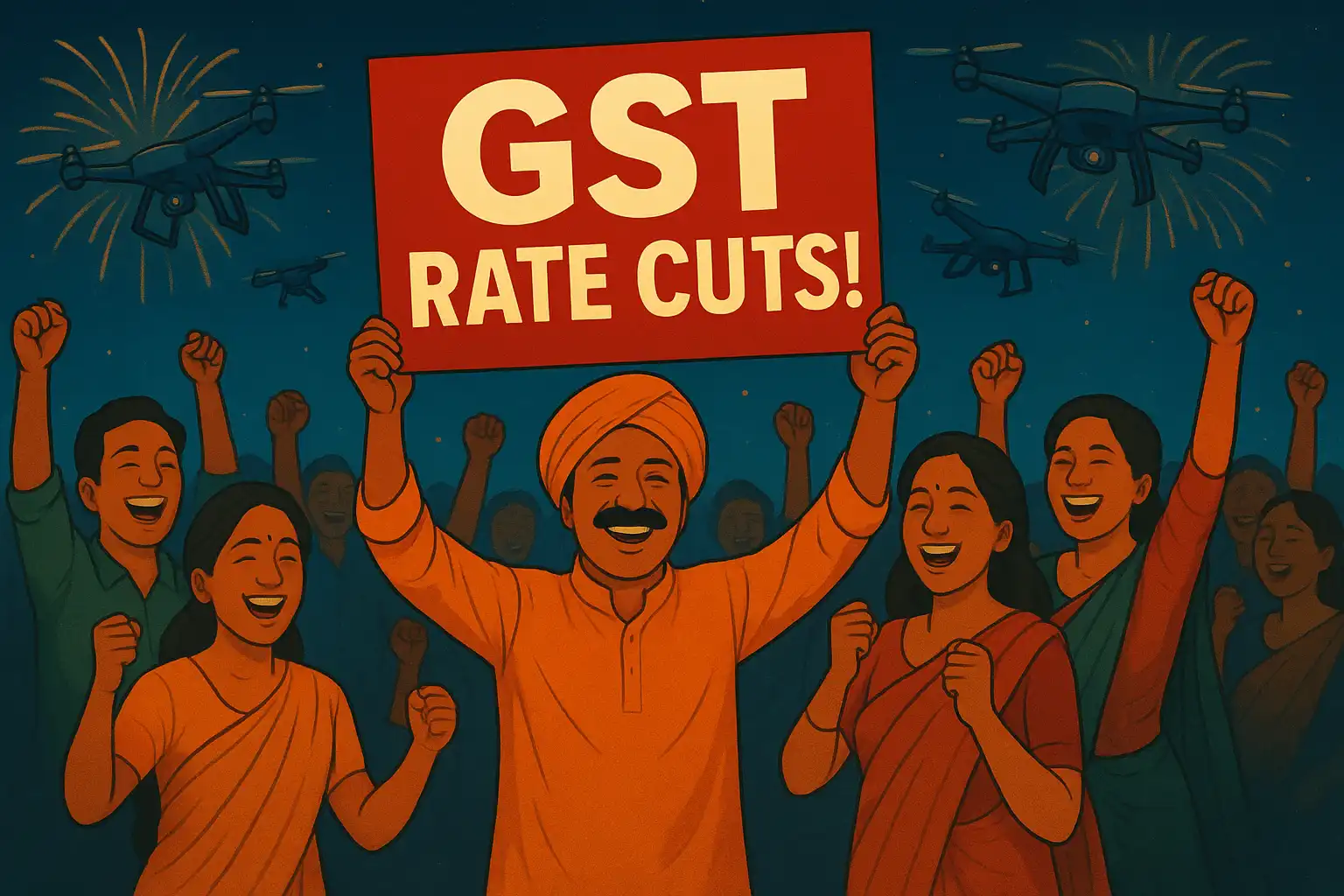
The Indian drone industry is rapidly evolving, driven by technological advancements and supportive government policies. The recent 56th Goods and Services Tax (GST) Council meeting has introduced significant tax structure changes for drones and their components, aligning with India’s ‘Make in India’ initiative. This post will detail these revisions, including the unified GST rate, implications for components, DGFT import restrictions, input tax credits, and new IGST exemptions. Understanding these shifts is crucial for stakeholders to navigate the new landscape and capitalize on opportunities.
Table of Contents:
1) Introduction
2) The 56th GST Council Meeting: A Paradigm Shift for Drones
3) Output Tax vs. Input Credits: Addressing the Inverted Duty Structure
4) DGFT Import Restrictions on Drones: A Continuing Policy
5) GST Treatment of Key Imported Drone Components
6) New IGST Import Exemptions Relevant to Drones
7) Compliance and Strategic Considerations for Drone Businesses
8) Conclusion
The 56th GST Council Meeting: A Paradigm Shift for Drones
The 56th GST Council meeting in September 2025 marks a pivotal moment for the Indian drone industry, aiming to foster growth and streamline taxation for unmanned aircraft.
Unified 5% GST Rate for Drones
The most impactful decision is the uniform 5% GST rate on all drones, replacing a fragmented tax structure (5% for business, 18% for camera-equipped, 28% for personal/hobby drones). This simplification reduces costs, encouraging wider adoption in agriculture, public safety, and infrastructure. It aims to democratize drone technology, making it more accessible and affordable.
Elimination of Higher Tax Slabs
This unified 5% rate aligns with a broader GST slab rationalization, collapsing rates to 5% and 18% for most goods. Drones previously in 18% or 28% slabs now fall under 5%. This contrasts with manned aircraft for personal use, which saw an increase from 28% to 40%, highlighting the government’s strategic promotion of drones as a technology booster. This signals strong industry support, stimulating demand and accelerating technological integration.
Effective Date and Industry Preparedness
The new GST rate takes effect from September 22, 2025. This provides businesses a short window to update tax codes, invoicing, and accounting. From this date, all drone sales will incur only 5% GST. This timely implementation allows for smooth transition, making drones more affordable and boosting demand in key sectors, aligning with government initiatives to increase drone usage. Businesses should adjust pricing and marketing to leverage these favorable conditions.
Output Tax vs. Input Credits: Addressing the Inverted Duty Structure
The 5% GST on finished drones creates a potential inverted duty structure for manufacturers, where input GST (e.g., 18% on parts) is higher than output GST. This can block working capital and impact liquidity.
Streamlined Refunds and Provisional Credits
To counter this, the Council introduced a 90% provisional refund of accumulated input GST credits, based on automated checks. This expedites the process, reduces administrative burden, and ensures manufacturers’ financial health, encouraging continued investment.
Strategic Procurement and Cash Flow Management
Manufacturers should claim these refunds by maintaining meticulous records, using accurate HSN codes, and timely filing GST returns (GSTR-1 and GSTR-3B). Sourcing more items locally under lower GST rates can also help manage inversion. This approach, combined with streamlined refunds, eases cash-flow strain, ensuring the tax reduction genuinely benefits manufacturers by preventing unutilized credits and fostering a virtuous cycle of demand and production.
DGFT Import Restrictions on Drones: A Continuing Policy
Despite GST changes, DGFT import restrictions on drones remain in place as of 2025, a cornerstone of India’s ‘Make in India’ strategy.
Import Ban on Complete Drones
The DGFT prohibits importing finished drones (CBU, SKD, CKD), with limited exceptions for R&D or defense/security, requiring specific licenses. Commercial entities cannot import off-the-shelf foreign drones without authorization, creating a protected market for domestic manufacturers.
Components Allowed: Fostering Domestic Manufacturing
The import ban does not extend to drone parts, which are classified as ‘Free.’ This encourages domestic assembly: manufacturers import parts (motors, frames, electronics) and build drones locally. This policy remains unchanged, ensuring value addition and employment generation within India.
Rationale and Continuity with ‘Make in India’
This policy aligns with India’s drone policy and PLI scheme, forcing local assembly and incentivizing foreign OEMs to invest in India’s drone ecosystem. This consistent approach signals a long-term commitment, requiring manufacturers to plan around component imports and domestic assembly, unless under specific exceptions.
Compliance Tips for Component Imports
Firms importing parts must maintain clear documentation, using correct HS codes (Chapter 88 for aircraft parts) to prove shipments are components, not complete drones, to avoid severe compliance actions. WPC clearances for radio-frequency modules are also essential. All standard import regulations (customs duties, safety certifications) apply and must be diligently followed.
GST Treatment of Key Imported Drone Components
While finished drones have a 5% GST, individual components vary. Most retain 18% unless classified as ‘aircraft parts’ at 5%. Accurate HSN codes are vital for compliance and cost optimization.
Remote Controller (e.g., Skydroid T12 – HS 8526.92.00)
Remote controllers are generally taxed at 18% GST as electronic equipment, not ‘aircraft parts.’ This applies to imported controllers (18% IGST, reclaimable as input credit). While defense-related communication devices may have IGST waivers, commercial controllers typically do not.
Flight Controller Module (e.g., Autopilot Board – HS 8807.30.20)
Flight controllers, integral to drone operation, are classified under HS 8807 (‘parts of aircraft’) and attract 5% GST. This rate remains unchanged and aligns with the finished drone’s rate. Correct HSN usage is crucial to avail this lower rate, including for import IGST.
Motors and Propellers (e.g., Brushless Motors, Prop Sets – HS 8807.30.20)
Drone motors and propellers, when specialized, fall under HS 8807 and qualify for 5% GST. This rate, unchanged by the Council, benefits local assembly. Generic motors/propellers used in non-drone applications might be taxed at 18%.
Airframe and Structural Parts (Frames, Airframe Kits, Landing Gear – HS 8807.30.00)
Drone chassis, airframes, and structural components are under HS 8807 and remain at 5% GST, consistent with the unified drone rate. Manufacturers should use Chapter 88 classification for these parts to benefit from the lower tax.
Spraying System Attachments (e.g., 5L Pesticide Sprayer Kit – HS 8424 or 8539)
Attachments like sprayer pumps and nozzles for agricultural drones lack specific GST concessions. They typically fall under general machinery parts (HS 8424) or electronics, attracting 18% GST. While some farm equipment saw reductions, drone-mounted sprayers did not. If bundled, the drone portion is 5%, but the sprayer value might be 18%, requiring careful taxation and compliance with mixed supply rules.
Lithium-Ion Battery (e.g., 22,000 mAh Li-Po Pack – HS 8507.60.00)
Drone batteries are classified as lithium-ion accumulators and carry 18% GST. The Council did not reduce this rate. While a specific IGST exemption exists for ‘high performance batteries for drones and specialized equipment’ (e.g., military/high-end industrial), typical commercial drone batteries still incur 18% IGST on import, reclaimable as input credit.
Battery Chargers and Power Units (e.g., 6S LiPo Charger – HS 8504.40.90)
Charging equipment and power adapters are electrical apparatus taxed at 18% GST, with no special rate introduced. Imported chargers face 18% IGST (refundable if registered), and domestically sold ones also carry 18% GST. Businesses should factor this into pricing, as the charger is taxed higher than the 5% drone. For composite supplies, it’s safer to charge 18% on spare or standalone chargers.
Payload Sensors & Electronics (e.g., LIDAR Module, RGB Camera, Radar Altimeter, Flow Meter)
Specialized drone sensors and payloads fall under various HSN categories (e.g., HS 8525 for cameras, 9026 for instruments) and generally attract 18% GST. No special category was created for drone-mounted sensors. However, for defense/government projects, new IGST exemptions for ‘parts, sub-assemblies, accessories for goods like aircrafts (including UAVs)’ may apply. Commercially, drone integrators should expect 18% IGST on most payload electronics and claim input credit.
In summary, core drone components (Chapter 88: airframe, propulsion, control) enjoy 5% GST, aligning with the finished drone. Generic/auxiliary items (batteries, standard electronics, payloads) remain at 18% (unless defense-exempt). Manufacturers must use correct HSN codes to avoid misclassification and maximize the 5% rate’s benefit, reducing overall drone cost.
New IGST Import Exemptions Relevant to Drones
The 56th GST Council introduced IGST exemptions for certain imports, primarily supporting defense and strategic sectors, with relevance to the drone industry.
Defense UAVs and Parts – IGST Exempt
Imports of defense-purpose UAVs are IGST-exempt, a significant but narrow concession as civilian drone imports remain banned. This extends to parts, sub-assemblies, spares, and accessories for defense goods (UAVs/aircraft). Companies on government defense projects can import components without IGST, provided they follow procedures (end-use certificates, defense procurement). This lowers tax costs for defense drone development, boosting indigenous defense tech.
High-Performance Drone Batteries – IGST Waiver
High performance batteries for drones and specialized equipment’ are IGST-exempt, targeting advanced battery systems for military/high-end industrial drones. This benefits cutting-edge drone programs (long-endurance, swarm drones) by allowing tax-free global sourcing of state-of-the-art batteries. It also incentivizes domestic advanced battery tech development.
Communication Equipment and Datalinks
The Council also granted IGST exemption to certain communication devices and accessories. This likely covers specialized communication modules and datalinks crucial for strategic drone operations (defense, security). These exemptions reduce costs for critical technologies, supporting advanced unmanned systems in India. Businesses should verify criteria for these exemptions.
Compliance and Strategic Considerations for Drone Businesses
Navigating India’s drone industry requires proactive compliance beyond GST changes.
Ensuring GST Compliance and HSN Code Accuracy
The 5% GST rate and component nuances demand strict GST compliance. Active GST registration, updated HSN codes, and accurate product descriptions are vital from September 22, 2025. Misclassifying parts (e.g., camera as ‘aircraft part’) can lead to audits and back-taxes. Meticulous record-keeping and timely GST returns (GSTR-1, GSTR-3B) are crucial for input tax credit refunds. Proactive internal audits help prevent discrepancies.
Other Regulatory Compliance: DGCA, WPC, BIS, CRO
Drone businesses must comply with DGCA’s Drone Rules (permissions for testing/operation, Digital Sky Platform registration). WPC approvals are essential for imported radio-frequency modules to avoid customs delays. BIS certification or CRO for electronics may also apply. Non-compliance can halt projects, so integrating these checks into procurement SOPs is vital.
Navigating the New Landscape: Opportunities and Challenges
The 56th GST Council meeting is positive for India’s drone industry. The 5% GST makes drones more affordable, stimulating demand. IGST exemptions for defense/high-performance components reinforce ‘Make in India.’ The DGFT import ban on finished drones remains, emphasizing local assembly. Businesses should highlight tax savings to customers, optimize supply chains for input taxes, and diligently claim credits/refunds. Understanding both import restrictions and GST tweaks is key to avoiding pitfalls and benefiting from government incentives, positioning enterprises strongly in this growing market.
Conclusion
The 56th GST Council meeting marks a new era for India’s drone industry with a simplified, favorable tax regime. The unified 5% GST and strategic IGST exemptions for defense-related imports and high-performance batteries reflect a clear government intent to accelerate sector growth and reinforce ‘Make in India.’ While the import ban on finished drones encourages domestic assembly, streamlined input tax credit refunds ease financial burdens. Navigating this landscape requires understanding GST implications and broader regulatory frameworks (DGCA, WPC, BIS, CRO). By adhering to guidelines, optimizing supply chains, and leveraging tax advantages, stakeholders can lead India’s drone revolution, contributing to economic development and national security.
Are you ready to harness the power of drones for your business or explore the exciting opportunities in India’s rapidly expanding drone industry?
At Skykart.in, we provide cutting-edge drone solutions, expert consultation, and comprehensive support to help you navigate the regulatory landscape and maximize your operational efficiency. Whether you are a manufacturer seeking to optimize your tax strategy, an enterprise looking to integrate drone technology, or an enthusiast eager to explore the latest advancements, our team is here to guide you.
Visit Skykart.in today to learn more about our products and services, and discover how we can help you soar to new heights in the world of drone